What will define the top reusable needle types in 2026? The answer depends on clinical purpose, material, sterilization capacity, and user training. A needle designed for dental procedures cannot automatically replace one made for biopsy, suturing, or laboratory sampling. Small differences matter. Tip geometry, shaft flexibility, gauge, and connection design can change handling and tissue response.
This guide examines major Reusable Needle categories, including surgical, dental, biopsy, acupuncture, and laboratory needles. It compares stainless steel grades, blunt and sharp tips, reusable hubs, and compatibility with validated sterilization systems. A well-made needle should resist corrosion, maintain its shape, and remain easy to inspect under bright light. Yet durability alone does not prove safety. Surface damage, blocked channels, or an imperfect seal can create serious risks.
The discussion follows evidence-based purchasing principles and professional infection-control guidance. Manufacturers’ instructions remain essential, especially for cleaning temperatures, cycle limits, and inspection intervals. Local healthcare rules may also differ. Some applications require single-use devices, even when a product appears reusable. That point deserves attention. A lower purchase price may become expensive after labor, testing, maintenance, and replacement are included. The most reliable choice is not always the sharpest or longest-lasting needle. It is the type that fits the procedure, supports consistent sterilization, and can be tracked responsibly from use to retirement. Real-world performance may also vary, so buyers should review clinical feedback, independent testing, and documented quality controls before making a 2026 decision.
Reusable needle selection should begin with dimensions, not labels. ISO 7864 defines hypodermic needle dimensions, including nominal gauge and length, but it addresses sterile single-use needles. It does not certify a needle as reusable. A 21G needle is approximately 0.8 millimeters in outer diameter, while a 25G needle is about 0.5 millimeters. Length commonly ranges from short designs near 16 millimeters to longer designs above 40 millimeters. Actual choice depends on fluid viscosity, access depth, and procedure control. Gauge alone is insufficient.
Steel grade requires separate verification. ISO 7864 does not provide a complete reusable-device material specification. Manufacturers should document the stainless-steel composition, surface finish, corrosion resistance, and resistance to repeated sterilization. Austenitic medical stainless steels are common, but “surgical steel” is too vague for technical purchasing. Review the material certificate. Check the declared grade.
This distinction matters clinically. The World Health Organization’s 2022 Global Report on Infection Prevention and Control reports healthcare-associated infections affecting about 7 of 100 hospitalized patients in high-income countries and 15 of 100 in low- and middle-income countries. Reprocessing quality therefore matters as much as needle geometry. A reusable design needs validated cleaning, inspection, packaging, and sterilization cycles. ISO 7864 can help compare gauge and length, but it cannot prove safe reuse. That is the uncomfortable gap. A better specification combines ISO dimensions with a documented steel grade and validated reprocessing evidence.
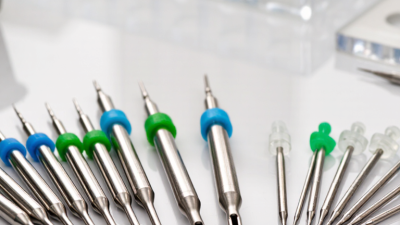
In 2026, “reusable needle” needs careful classification. A reusable device must tolerate validated cleaning, packaging, and sterilization cycles. Most hypodermic needles remain single-use because CDC injection-safety guidance prohibits reusing needles or syringes between patients. Dental needles follow the same rule, even when a metal syringe body is reusable. Small gauges, sharp tips, and blood residue make casual cleaning unreliable. The needle is not the syringe.
Acupuncture needles are commonly sterile, prepacked, and single-use. Tattoo needles are also generally disposable, supporting safer control of blood exposure. Surgical needles differ slightly: some specialized needles may be processed in regulated facilities, but many suturing needles are supplied sterile for one procedure. WHO’s 2022 infection-prevention report found healthcare-associated infections affect about 7 in 100 acute-care patients in high-income countries, and 15 in 100 in low- and middle-income countries. That gap makes reprocessing quality more than a technical detail. A 2023 WHO and UNICEF monitoring report also found that roughly half of healthcare facilities worldwide lacked basic hygiene services in 2022. These figures do not prove that reuse causes every infection. They do show why validated sterilization matters. My practical concern is simple: “reusable” should describe documented equipment performance, not a hopeful cleaning routine.
Classify 2026 Types: Hypodermic, Dental, Acupuncture, Tattoo, and Surgical
| Needle Type | Typical Reusable Configuration | Common Size Range | Primary Applications | Key Design Features | Reusable Status in Current Practice | Recommended Reprocessing Considerations |
|---|---|---|---|---|---|---|
| Hypodermic Needles | Reusable stainless-steel needle with a compatible syringe or reusable medical instrument, mainly in controlled specialty or laboratory settings. | Approximately 18–30 gauge; length commonly 0.5–2 inches, depending on the procedure. | Fluid withdrawal, laboratory procedures, veterinary work, and selected clinical procedures where an approved reusable system is available. | Hollow shaft, beveled tip, and standardized hub. Gauge number increases as outside diameter decreases. | Limited and Conditional Most routine clinical hypodermic needles are manufactured for single use because of infection-control and sharpness requirements. |
Use only when the needle is specifically designed and authorized for reuse. Clean immediately, inspect the bevel and lumen, package appropriately, and sterilize according to validated instructions. |
| Dental Needles | Reusable needle components may be used with certain reusable dental aspirating syringe systems, although the needle itself is commonly disposable. | Common dental needle gauges include approximately 27–30 gauge; short and long lengths are selected according to injection site. | Local anesthetic delivery for infiltration, nerve blocks, and other dental injections. | Small-gauge hollow shaft, dental syringe compatibility, and bevel geometry designed for controlled tissue penetration. | Very Limited Modern infection-control practice generally favors sterile, single-use dental needles. Reuse is not appropriate unless the complete system is expressly validated for it. |
Do not reuse a disposable dental needle. For approved reusable components, follow validated cleaning and steam-sterilization procedures and inspect for blockage, bending, or surface damage. |
| Acupuncture Needles | Historically reusable solid metal needles; in contemporary regulated practice, sterile single-use needles are generally preferred. | Commonly about 0.12–0.35 mm in diameter and 15–100 mm in length, with substantial variation by treatment site. | Acupuncture, dry needling, and selected traditional or complementary medicine procedures. | Solid, flexible shaft; pointed tip; often a coiled or looped handle. Unlike hypodermic needles, they do not contain a hollow lumen. | Limited and Jurisdiction-Dependent Reusable acupuncture needles require strict validated decontamination and are restricted or discouraged in many modern practice settings. |
If reuse is legally permitted, use a validated cleaning, ultrasonic-cleaning where appropriate, packaging, and sterilization process. Discard any needle with a damaged tip, corrosion, or deformation. |
| Tattoo Needles | Reusable needle bars, needle groupings, or needle tips made from stainless steel may be sterilizable; many modern cartridge systems are designed for single use. | Common groupings include liners, shaders, and magnums; individual needle diameters often range approximately from 0.25–0.40 mm. | Depositing pigment into the dermis to create lines, shading, color packing, and cosmetic pigmentation effects. | Multiple needle points soldered or fixed in a configuration; grouping and taper influence line width, saturation, and skin trauma. | Conditional Reusable metal components may be used only when designed for validated sterilization. Disposable cartridges and membranes must not be reused. |
Remove visible soil promptly, clean with an approved process, package individually, and sterilize in a validated steam cycle. Use protective barriers on the machine and dispose of contaminated single-use parts safely. |
| Surgical Needles | Reusable surgical needle-like instruments include certain biopsy, aspiration, guiding, or specialized instrument components; standard suture needles are generally disposable. | Size varies widely by procedure; suture needle dimensions are specified by curvature, length, and point design rather than hypodermic gauge alone. | Biopsy, aspiration, tissue approximation, guided access, and specialized surgical procedures. | May be hollow or solid; tip shapes include cutting, reverse-cutting, taper, blunt, and trocar designs. Curvature and point geometry are procedure-specific. | Specialized and Conditional Reusable status depends on the exact instrument. Most conventional suture needles are intended for single use because repeated processing can affect sharpness and structural integrity. |
Follow the instrument-specific reprocessing instructions. Inspect for dulling, bending, corrosion, lumen obstruction, and compromised surfaces before sterilization and reuse. |
| Important note: “Reusable” describes a device that is specifically designed, labeled, and validated for repeated use. A metal needle is not automatically reusable. Always follow applicable medical-device regulations, local infection-control requirements, and the manufacturer’s validated reprocessing instructions. Size ranges are indicative and vary by procedure, region, and needle design. | ||||||
In 2026, reusable needle selection depends on tip geometry and verified tubing performance. ISO 9626 does not rank needle tips. It establishes requirements for stainless steel needle tubing used in medical devices. Key checks include outside diameter, wall thickness, surface quality, cleanliness, stiffness, and resistance to breakage.
A regular bevel creates a balanced cutting edge for many general procedures. A short bevel can improve control but may require greater insertion force. A lancet-style bevel forms a longer, sharper point and often supports smoother penetration. Side-port designs direct fluid differently, yet their openings can complicate cleaning and inspection during reuse.
Geometry matters. Tip length, bevel angle, and symmetry should match the intended application. A practical evaluation includes microscopic inspection, dimensional measurement, and repeated cleaning validation. ISO 9626 testing can support material and mechanical decisions, but it cannot replace complete device testing. The standard also does not prove that one bevel feels better for every user.
A common mistake is judging sharpness alone. Reusable assemblies face wear, residue, corrosion, and accidental bending. Small surface defects may become more important after repeated processing. In real laboratory assessments, results can vary between operators, instruments, and cleaning cycles. That uncertainty deserves documentation, not convenient assumptions.
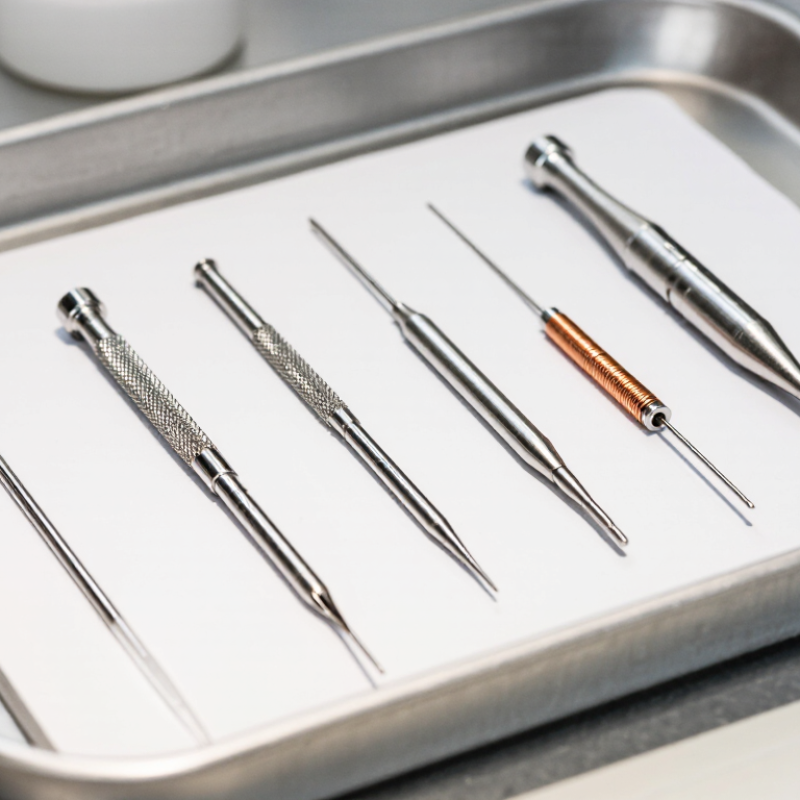
Reusable needles should never be selected by appearance alone. The safer categories include solid acupuncture needles, reusable biopsy needles, and specialized surgical needles designed for validated reprocessing. Many hollow needles remain single-use devices. Reusing them without authorization can retain blood, tissue, or microscopic damage. That risk is easy to underestimate.
Under CDC Spaulding principles, a needle entering sterile tissue or the vascular system is a critical device. It requires cleaning followed by sterilization, not routine disinfection. AAMI ST79 provides practical guidance for steam sterilization, including inspection, packaging, cycle monitoring, storage, and staff competency. The needle’s instructions for use must permit reprocessing. If those instructions are missing, stop and investigate. A shiny surface proves very little.
Tips:
Use a point-of-use transport container. Remove visible soil promptly. Check the tip under magnification. Reject bent, scratched, clogged, or blunt needles. Record each sterilization cycle and indicator result. Keep sterile packs dry and sealed. In practice, staff may rush cleaning when procedure volume rises. That is a real weakness, not a minor detail. A validated process can still fail through poor handling, overloaded chambers, or incomplete drying. Regular audits, documented training, and independent infection-control review help expose those gaps.
What Are the 2026 Top Reusable Needle Types?
Selecting a reusable needle in 2026 requires more than comparing purchase prices. Solid stainless-steel acupuncture needles often offer strong durability and simple visual inspection. Their smooth shafts resist bending during routine use. However, they still require validated cleaning, sterilization, and tracking procedures. A lower-cost needle can become expensive when processing time, damaged instruments, and staff training are included. Very short.
Some specialized hollow needles may support reprocessing, but only when their technical documentation clearly allows it. Many hollow medical needles are single-use devices. Reusing them without validated instructions can increase contamination, blockage, and tissue-trauma risks. Clinical fit matters too. Practitioners should match gauge, length, tip design, flexibility, and tactile feedback to the procedure. A durable needle may feel unsuitable in delicate tissue. A cheaper option may bend too easily during deeper placement. In practice, inspection under bright light helps reveal burrs, corrosion, and distorted tips. Records should identify each processing cycle and any failed inspection. That sounds excessive, yet small defects can affect control. Cost analysis should include sterilizer capacity, packaging, labor, maintenance, and replacement frequency. Durability is useful only when performance remains consistent. I would also question attractive claims based only on laboratory testing. Real clinical handling, cleaning complexity, and user feedback deserve equal weight.