

Leave Your Message
How to Make Pigs Drink More Water: 5 Science-Backed Strategies
Key Takeaways
- Pigs require 3–6 liters of water daily per kg of feed consumed, with higher needs for lactating sows (25–40 liters/day).
- Water quality (pH 6.5–8.5, <1,000 ppm TDS) and nipple drinker flow rates (500–1,000 mL/min) directly impact intake.
- Electrolyte-enhanced water can boost consumption by 15–20% during heat stress (University of Nebraska, 2022).
- Poor hydration reduces feed conversion ratios (FCR) by 10–25% and increases disease susceptibility.
Why Water Intake is Critical for Swine Health and Productivity
Water drives nutrient absorption, thermoregulation, and waste elimination in pigs. A 2023 University of Minnesota study found that a 10% increase in water intake improved average daily gain (ADG) by 6.8% in growing-finishing pigs. Yet, 35% of commercial farms fail to meet optimal hydration targets due to outdated systems or management gaps.
This guide outlines proven strategies to maximize water consumption in swine operations across the Americas.
5 Strategies to Increase Water Consumption in Pigs
1. Optimize Water Delivery Systems
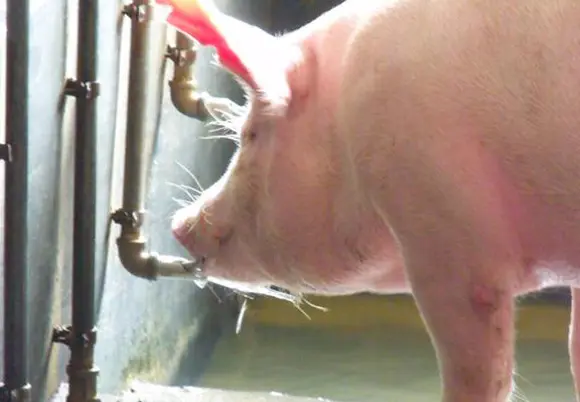
- Nipple Drinker Specifications:
- Height: Adjust to shoulder level (15–20 cm for weaners, 55–65 cm for sows).
- Flow Rate: 500 mL/min for nursery pigs; 1,000 mL/min for finishing pigs.
- Trough Systems: Ensure 2–3 cm of linear trough space per pig to reduce competition.
Pro Tip: Install pressure regulators to maintain consistent flow rates as herds grow.
2. Enhance Water Palatability
- Temperature: Maintain water at 10–20°C (50–68°F)—cold water boosts intake by 18% in heat-stressed pigs (Iowa State University, 2023).
- Additives:
- Electrolytes: Use during weaning or heatwaves (0.2–0.5% solution).
- Apple cider vinegar: 0.5% dilution improves palatability and gut health.
3. Strategic Feeder-Waterer Placement
- Proximity: Place drinkers ≤3 meters from feeders (reduces “lazy drinking” by 30%).
- Lighting: Ensure 50–100 lux at drinkers for 16–18 hours daily.
4. Manage Environmental Stressors
- Heat Stress Mitigation:
- Sprinklers: Run 3–5 minutes/hour when temps exceed 25°C (77°F).
- Shade Structures: Maintain ambient temps <28°C (82°F) in pens.
- Air Quality: Ammonia levels <25 ppm prevent respiratory irritation that suppresses thirst.
5. Monitor and Adjust
- Daily Checks:
- Measure water meter readings per pen.
- Test water pH, TDS, and bacterial counts weekly.
- Tech Solutions:
- RFID-enabled drinkers (e.g., Big Dutchman AquaCheck) track real-time consumption.
- Automated dosage systems for additives (e.g., Oxyion®).
Regional Considerations for U.S., Mexico, and South America
| Region | Challenge | Solution |
|---|---|---|
| U.S. Midwest | Hard water scaling | Install reverse osmosis systems |
| Mexico | High ambient temperatures | Electrolyte supplements + shade |
| Brazil | Seasonal droughts | Rainwater harvesting + storage |
Economic Impact of Improved Hydration
A 2022 trial on a 5,000-head Indiana farm showed that optimizing drinker flow rates and electrolyte use:
- Increased water intake by 22%
- Improved FCR from 2.85 to 2.67
- Generated $3.18 extra profit per pig
FAQ: Boosting Water Intake in Swine
Q1: How much water do lactating sows need daily?
A: 25–40 liters, depending on litter size and ambient temperature.
Q2: Can vinegar in water corrode nipple drinkers?
A: Yes—use 316 stainless steel nipples for acidic additives.
Q3: What’s the ideal water-to-feed ratio for growing pigs?
A: 3:1 (3 liters water per 1 kg feed) under thermoneutral conditions.
Q4: How to check nipple drinker flow rates?
A: Hold a graduated cylinder under the nipple for 15 seconds and multiply by 4.
Q5: Do pigs drink more at night?
A: Yes—40% of intake occurs during cooler nighttime hours. Ensure 24/7 access.
Maximizing water intake in pigs requires a holistic approach—combining precision equipment (e.g., flow-regulated nipple drinkers), environmental management, and data-driven monitoring. By implementing these strategies, farms can enhance growth rates, reduce veterinary costs, and meet evolving welfare standards across global markets.
Ready to upgrade your swine hydration system? [Explore our farm-tested waterers] or contact our WANJIA team for a free barn assessment.